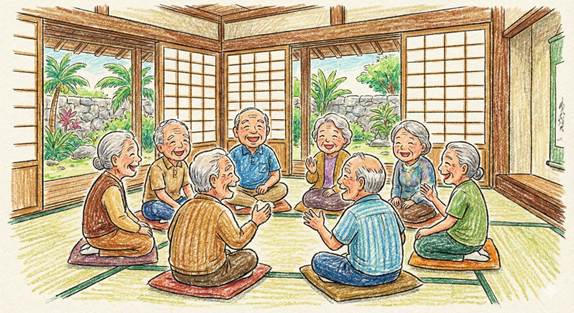
Dialogues in Chimugurisa
About Our Dialogue Space
Why We Began Dialogues in Chimugurisa
“How have those who survived the war gone on living each day, carrying what they lived through?”
This was the question that first took root in me when I was a university student, working on my graduation thesis about the Battle of Okinawa.
Even then, mental health surveys had shown that many people in Okinawa were living with psychological wounds believed to be linked to the war.
The year I conducted my own research—2000—marked 55 years since the battle had ended.
What I learned through two rounds of interviews was this:
for many people, the war had never truly ended.
Even more than half a century later, many were still living with the pain and trauma of what they had endured.
This realization didn’t shock me—it felt, sadly, inevitable.
After all, they had lived through a war that had turned their homes and villages into battlegrounds.
What does it mean to keep living in a place that once became a battlefield?
Even after the war ended, U.S. military bases remained.
Incidents and accidents involving those bases continued, reminding people of the war again and again.
In that space between war and memory, I met people who began to speak.
- “I’ve never talked about the war. I avoided it because I didn’t want to remember.
But before I die, I’d like to speak about it—if I can do so in a place where I feel safe.” - “I wish there were a space where people who lived through the same times could speak freely, without hesitation.”
- “I thought I was the only one who had suffered. But now I see—others have, too.”
Many had never been given the chance—or the invitation—to speak.
Their memories had lived quietly inside them, unspoken but never forgotten.
When one person said:
- “I wish there were a place where those who lived through the same war could speak, safely, together,”
—something shifted.
If people who have carried the pain of war for a lifetime still have something they want to do before they leave this world,
I want to help make that possible.
And so, in 2005, the Katariai no Ba—the Dialogue Space—was born.
What Is the Dialogue Space?
In its first year, we held gatherings at seven locations across Okinawa, with 73 participants.
The average age was 77.7 years.
We met once a month in a semi-closed format, and whenever someone new wished to join, we only moved forward with the full consent of all members.
Each group was different.
Some sessions had suggested themes—such as “Let’s talk about our experiences during the war.”
Others allowed stories to emerge naturally through walks, shared meals, or community activities.
In some places, families and local elementary school students also joined.
There were disagreements at times, moments of tension.
But always, we prioritized dialogue—asking together:
What kind of space do we want this to be?
That process of co-creating the space was, in itself, part of the healing.
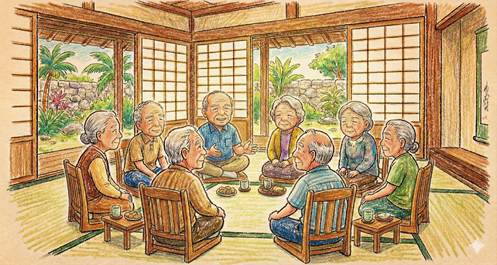
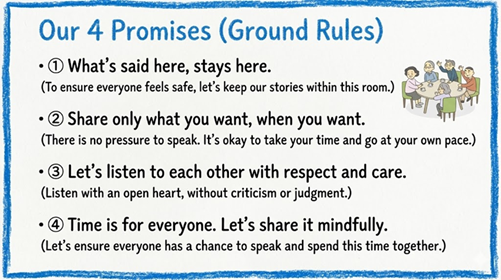
The Process and Our Promises
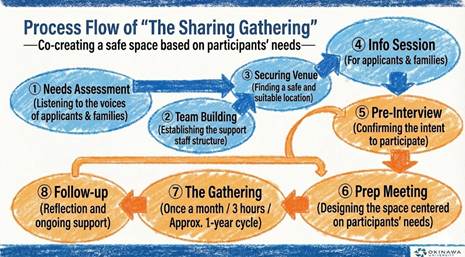
Each Dialogue Space required careful preparation. We committed to the following:
- Listening deeply to participants and their families
— about their hopes, fears, and the kind of support they might need. - Forming a care team
— often including nurses or mental health professionals, to ensure safety and trust. - Finding and preparing venues
— which sometimes required creative solutions when a space was unavailable or hesitant to host. - Holding orientation sessions (with families invited)
— to explain that emotional responses could emerge after sharing, and to make space for understanding and care. - Conducting pre-dialogue interviews
— sometimes two, sometimes more than thirty, depending on the person’s comfort and readiness. - Holding “preparation meetings” with participants
— to talk about what kind of space they wished to create, and to adjust group direction to meet evolving needs.
When necessary, we supported people in moving to other kinds of activities that felt right for them.
Each year was one cycle.
At the end of each year, we asked participants if they wished to continue.
And so, the Dialogue Space changed—gently, organically—along with the people who shaped it.
What the Dialogue Space Offers
This “gathering for storytelling” is a sanctuary—a place where you can speak your heart, free from judgment or pressure.
It is not a place divided between “speakers” and “listeners.” Instead, it is a space where those who have carried pain together draw close, allowing their hearts to resonate with one another.
Here, words held in silence find their voice; voices weave connections between people; and dialogue transforms into memory for the future.
It is also a place where we share the simple joy of being alive, and where we find laughter together.
This is what we call Dialogues in Chimugurisa.